Medical Fellowships for Residents: What You Need to Know
Fellowship training after residency is increasingly common — and increasingly competitive. Whether you're pursuing a subspecialty, building research credentials, or pivoting your career, finding the right fellowship is a major decision.
Here's what you need to know about the fellowship landscape in 2026.
Types of Fellowships
ACGME-Accredited Subspecialty Fellowships
These are the "standard" fellowships — formalized training programs accredited by ACGME that lead to board eligibility in a subspecialty. Applied through ERAS/NRMP or specialty-specific match systems.
Examples: Cardiology, GI, Pulm/Crit Care, Heme/Onc, Endocrine, Rheum, ID
Non-ACGME Fellowships
Specialized training programs that don't go through the Match. Often in niche areas or newer subspecialties. Applied directly to institutions.
Examples: Sports Cardiology, Interventional Pulmonology, Transplant Hepatology, Global Health, Medical Education, Simulation
Research Fellowships
Dedicated research training, often 1-2 years, at academic medical centers. May be part of a T32 grant or institution-funded. Great for academic career tracks.
Teaching / Education Fellowships
Growing category for residents interested in medical education careers. Chief resident roles, simulation fellowships, and curriculum development positions.
How to Find Fellowships
The Problem
Fellowship information is scattered across:
- FREIDA (AMA database — comprehensive but hard to filter)
- Specialty society websites (one per subspecialty)
- Individual program websites
- Word of mouth from attendings
A Better Way
AspireMed aggregates fellowship opportunities across specialties in one searchable database. Filter by specialty, type, location, and eligibility. Our AI matching engine ranks fellowships based on your profile, interests, and career goals.
Every listing includes:
- Application deadlines (with rolling deadline tracking)
- Eligibility requirements
- Direct application links
- IMG eligibility status
Timeline
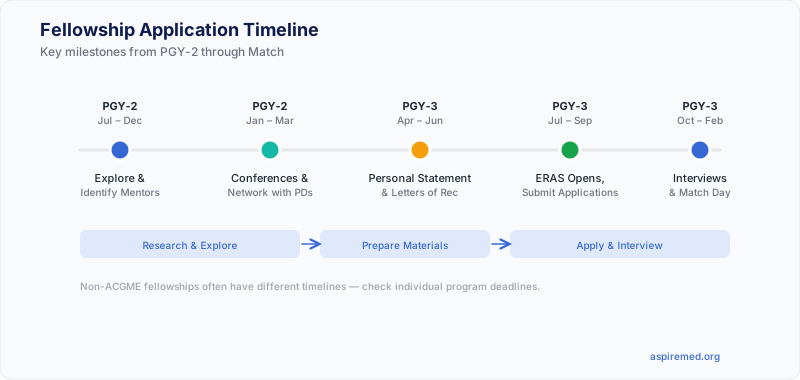
| When | What |
|---|---|
| PGY-2 (July-Dec) | Research programs, identify mentors, start exploring |
| PGY-2 (Jan-Mar) | Attend specialty conferences, network with PDs |
| PGY-3 (Apr-Jun) | Finalize personal statement, gather LORs |
| PGY-3 (Jul-Sep) | ERAS opens, submit applications |
| PGY-3 (Oct-Feb) | Interviews + Match |
Non-ACGME fellowships often have different timelines. Check individual program deadlines.
What Programs Look For
- Research productivity — publications, presentations, grants
- Clinical excellence — evaluations, board scores
- Letters of recommendation — ideally from faculty in the subspecialty
- Institutional fit — genuine interest in the program, not just the location
- Career vision — what you'll do with the training
Start Your Search
Browse fellowship opportunities on AspireMed — filtered by specialty, with AI-powered matching to find the best fits for your career stage and goals. Free for all trainees.
Find your next opportunity
Browse 450+ medical opportunities with AI-powered matching — free for all trainees.